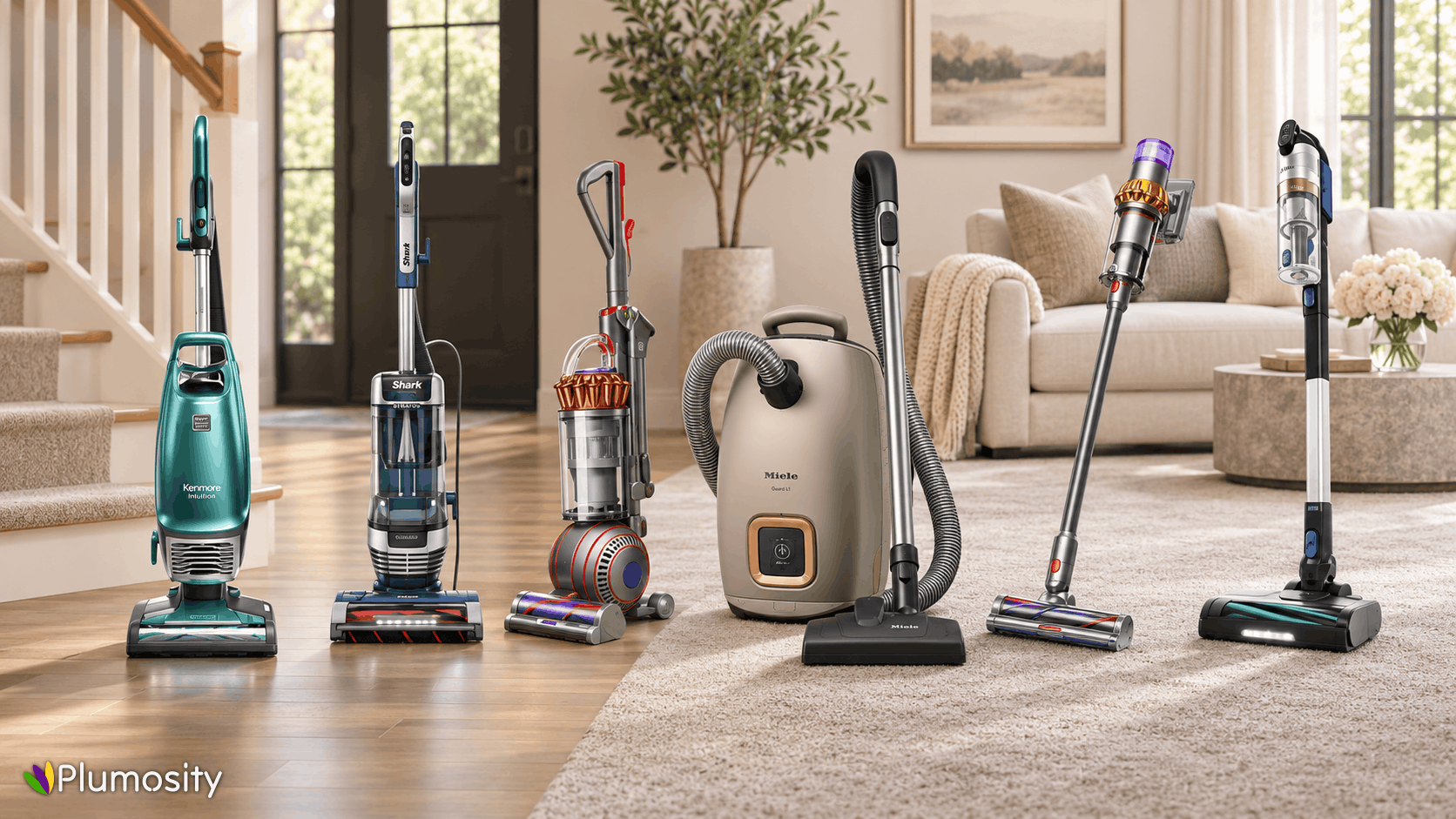
The Right Vacuum Depends on Your Home
A vacuum that excels in one home can disappoint in another. A powerful upright may deep-clean carpets but feel cumbersome on stairs. A lightweight cordless model makes everyday cleaning easier but may lack the battery life for larger homes.
The right choice depends on more than suction power or price. Flooring, pets, and cleaning habits all matter, as do weight, maneuverability, dust capacity, and maintenance.
Spending more doesn't guarantee better performance. Independent testing shows that affordable vacuums can outperform premium competitors on specific surfaces.
We examined independent test results, weighed practical advantages and limitations, and selected six vacuums for six different household needs to help you find the right fit.
The Short Answer: Which Vacuum Should You Buy?
Start with your home's most demanding cleaning requirement. Then choose the vacuum that makes meeting that requirement easiest.
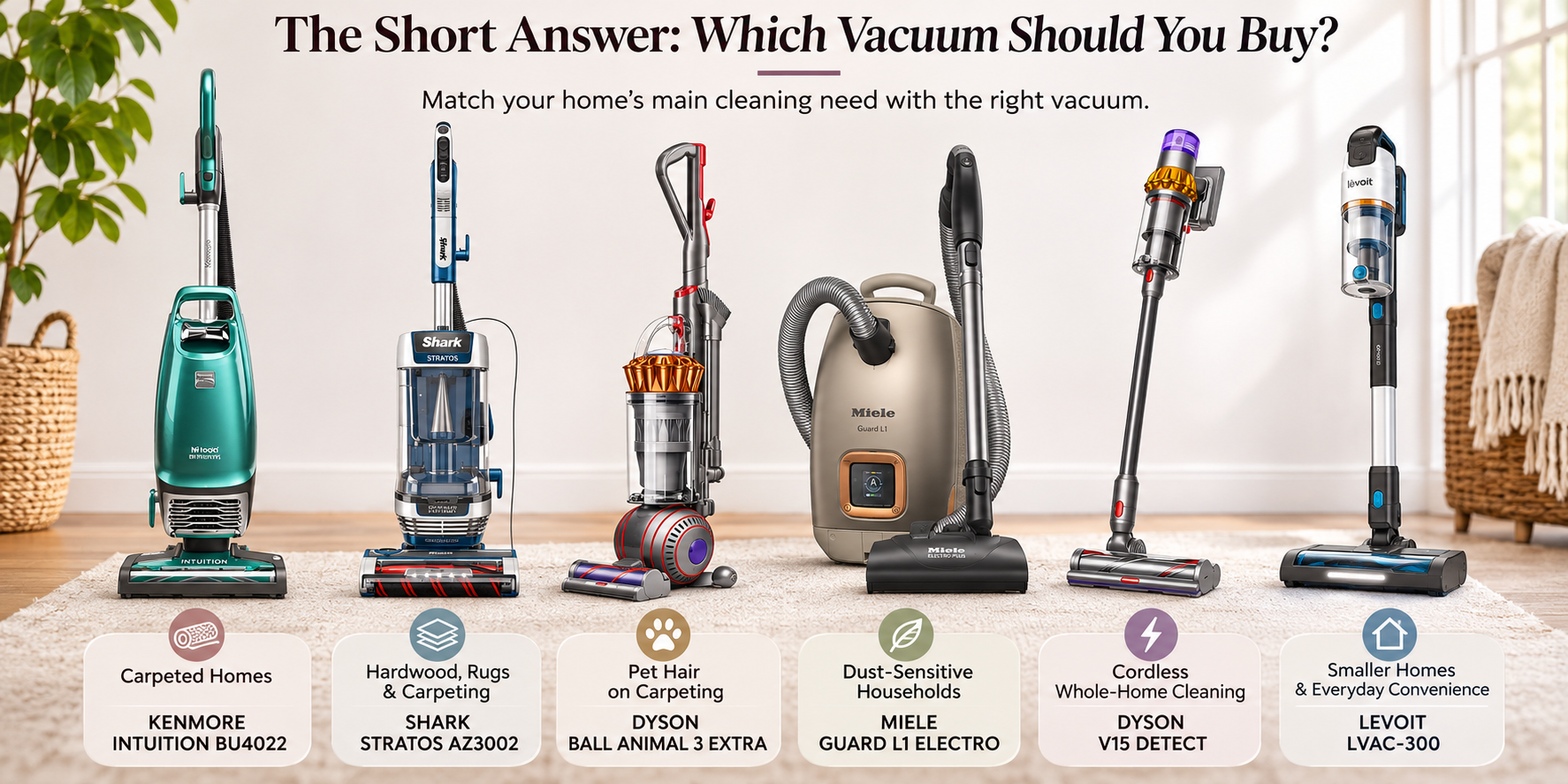
Thick carpeting calls for effective embedded-debris pickup. Hardwood and rugs require a floorhead that can handle different surfaces. Pet owners need effective hair removal, while dust-sensitive households should consider both filtration and what happens when collected debris is discarded.
| Your Main Priority | Our Pick | Why It Stands Out | Biggest Tradeoff |
|---|---|---|---|
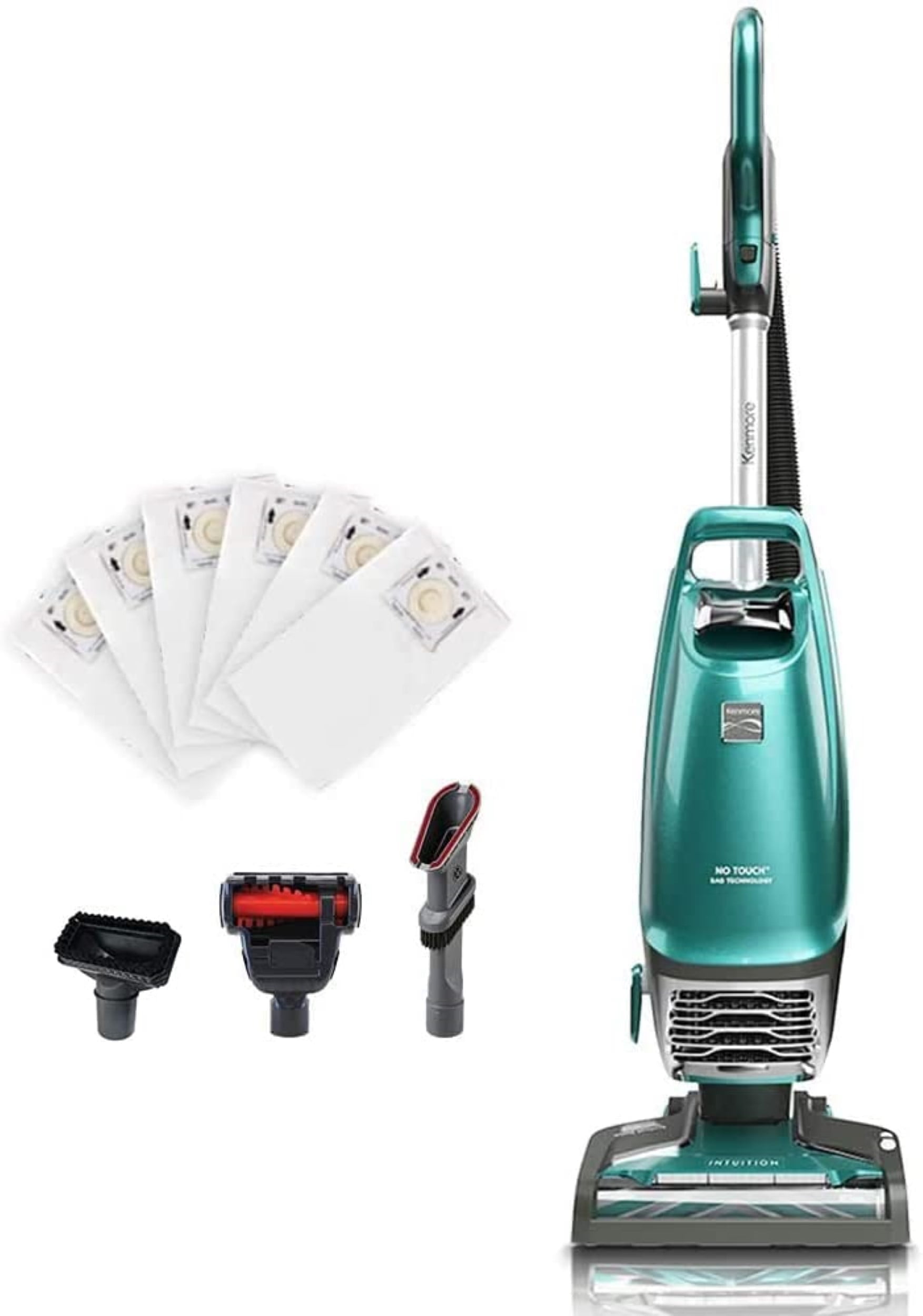
| Mostly carpeted homes | Kenmore Intuition BU4022 | Excellent tested carpet-debris pickup and cleaner bag disposal at an accessible price | Brushroll hair accumulation and less-premium construction |
| Hardwood, rugs, and carpeting | Shark Stratos AZ3002 | Dual-roller floorhead handles different surfaces without routine attachment changes | Bulky design and inconsistent deep-carpet results |
| Pet hair on carpeting | Dyson Ball Animal 3 Extra | Outstanding tested pet-hair pickup, particularly on high-pile carpets | Heavy, sometimes difficult to push, and bagless |
| Dust-sensitive households | Miele Guard L1 Electro | Exceptional measured filtration, sealed bags, and a powered carpet head | Very high price and recurring bag and filter costs |
| Cordless whole-home cleaning | Dyson V15 Detect | Strong cleaning across multiple floor types with excellent cordless versatility | Battery endurance, small bin, and bagless disposal |
| Smaller homes and everyday convenience | Levoit LVAC-300 | Effective hard-floor cleaning, practical capacity, self-standing design, and good value | Less effective on demanding thick carpets |
Important: Each recommendation is selected for a particular household need—not because it wins every cleaning test. Carpet construction, exact product configuration, and everyday handling can change which vacuum is appropriate for your home.
Four Decisions That Matter Most
The biggest vacuum-buying mistakes happen when one desirable feature comes at the expense of something more important. Before comparing individual models, consider where your cleaning needs might conflict.
1. Carpet Performance vs. Floorhead Versatility
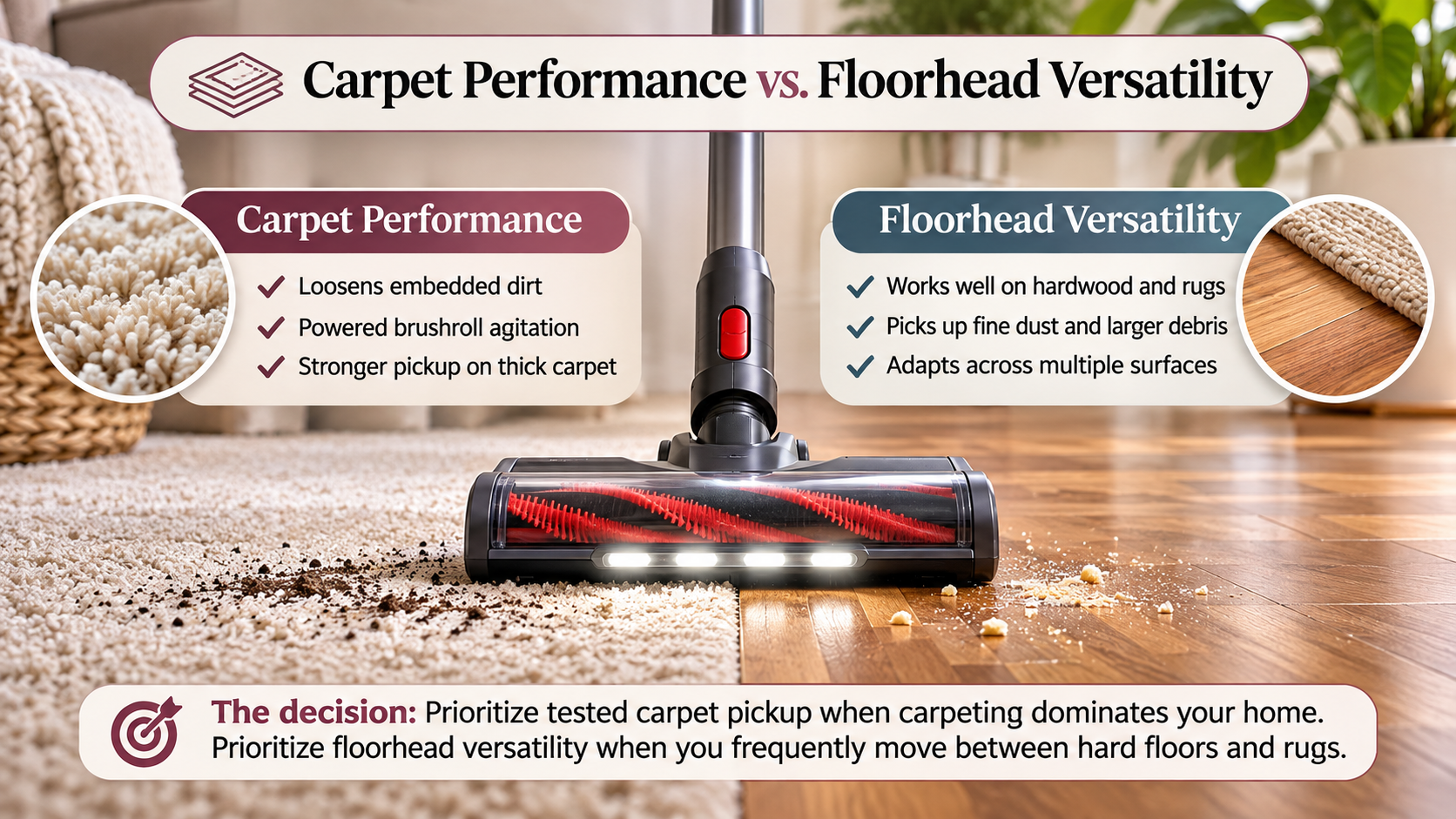
Thick carpeting and hardwood floors place different demands on a vacuum. Carpet fibers can trap debris below the surface, where powered brushroll agitation and effective airflow help loosen and collect dirt. Hardwood generally benefits from a cleaning head that picks up fine dust and larger particles without excessive agitation.
The difference is measurable. In TechGearLab's upright-vacuum comparison, the Kenmore Intuition BU4022 removed 73% of test debris from high-pile carpet, compared with 52% for the Shark Stratos AZ3002. The Stratos performed better on hardwood, collecting 97% of test debris compared with Kenmore's 90%.
Neither result establishes universal superiority. It shows why a household dominated by carpeting may benefit from a different design than one containing hardwood, rugs, and smaller carpeted areas.
The floorhead matters more than impressive suction specifications alone. Brushroll design, height adjustment, suction control, and debris clearance all affect actual pickup.
The decision: Prioritize independently tested carpet pickup when carpeting dominates your home. Prioritize floorhead versatility when you frequently move between hard floors and rugs.
2. Pet-Hair Removal vs. Dust Containment
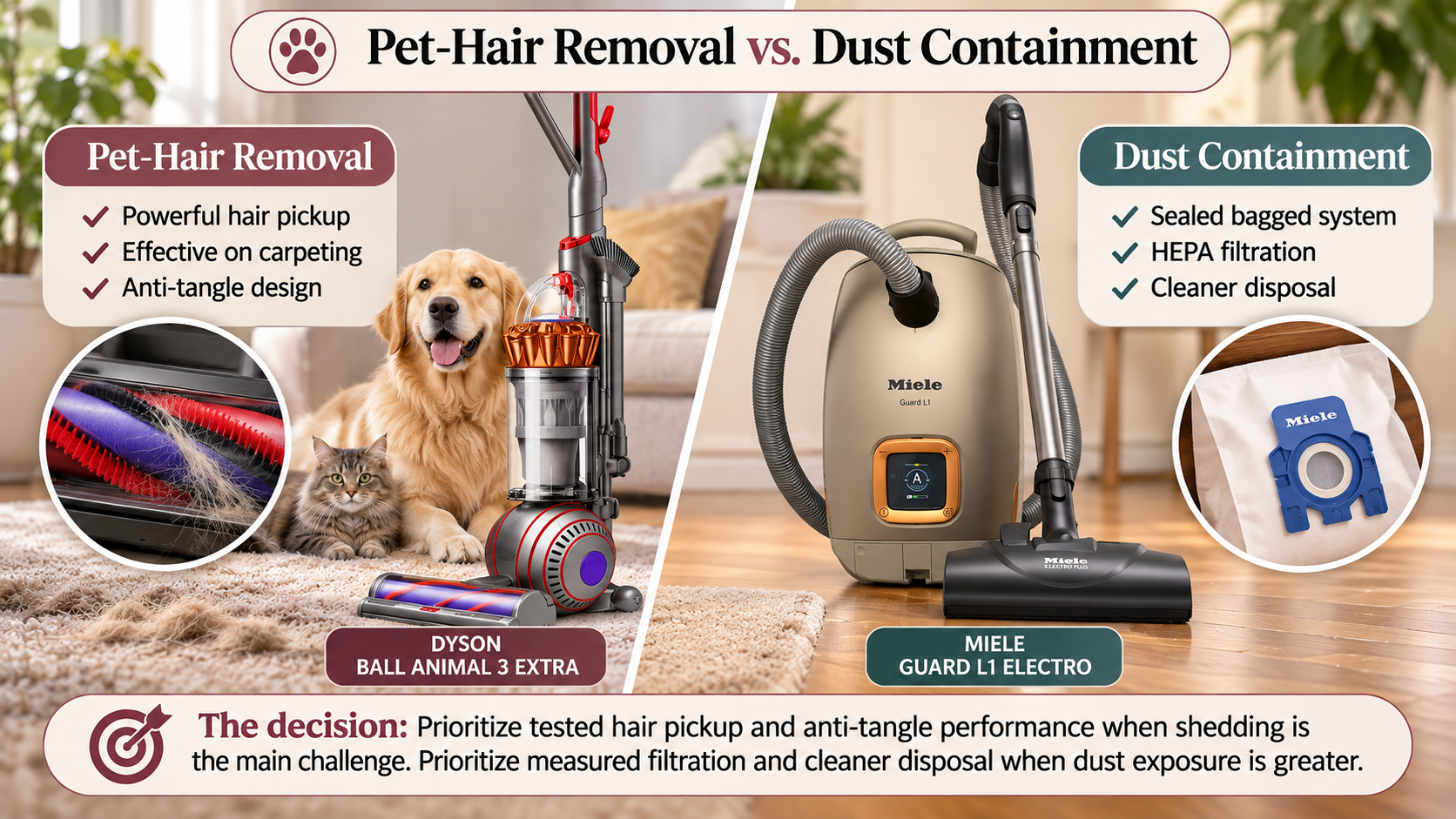
Pet owners often need to solve two different problems: removing hair from carpets and furniture, and keeping collected dust and debris contained.
A vacuum can excel at one without being the best choice for the other.
The Dyson Ball Animal 3 Extra demonstrates excellent hair-removal performance, particularly on carpeting. But its bagless dustbin must be emptied manually, potentially disturbing accumulated fine particles.
The Miele Guard L1 Electro takes a different approach. Its sealed bagged system and included HEPA AirClean filter produced exceptionally good results in independent air-quality testing.
Three factors matter here: how much hair the machine collects, how effectively it contains particles while operating, and how much dust escapes during disposal.
These distinctions also explain why a HEPA label alone is insufficient. Whole-machine sealing and disposal design influence the complete experience.
The decision: Prioritize tested hair pickup and anti-tangle performance when shedding is the main challenge. Prioritize measured filtration and cleaner disposal when dust exposure is the greater concern.
3. Cordless Convenience vs. Uninterrupted Cleaning
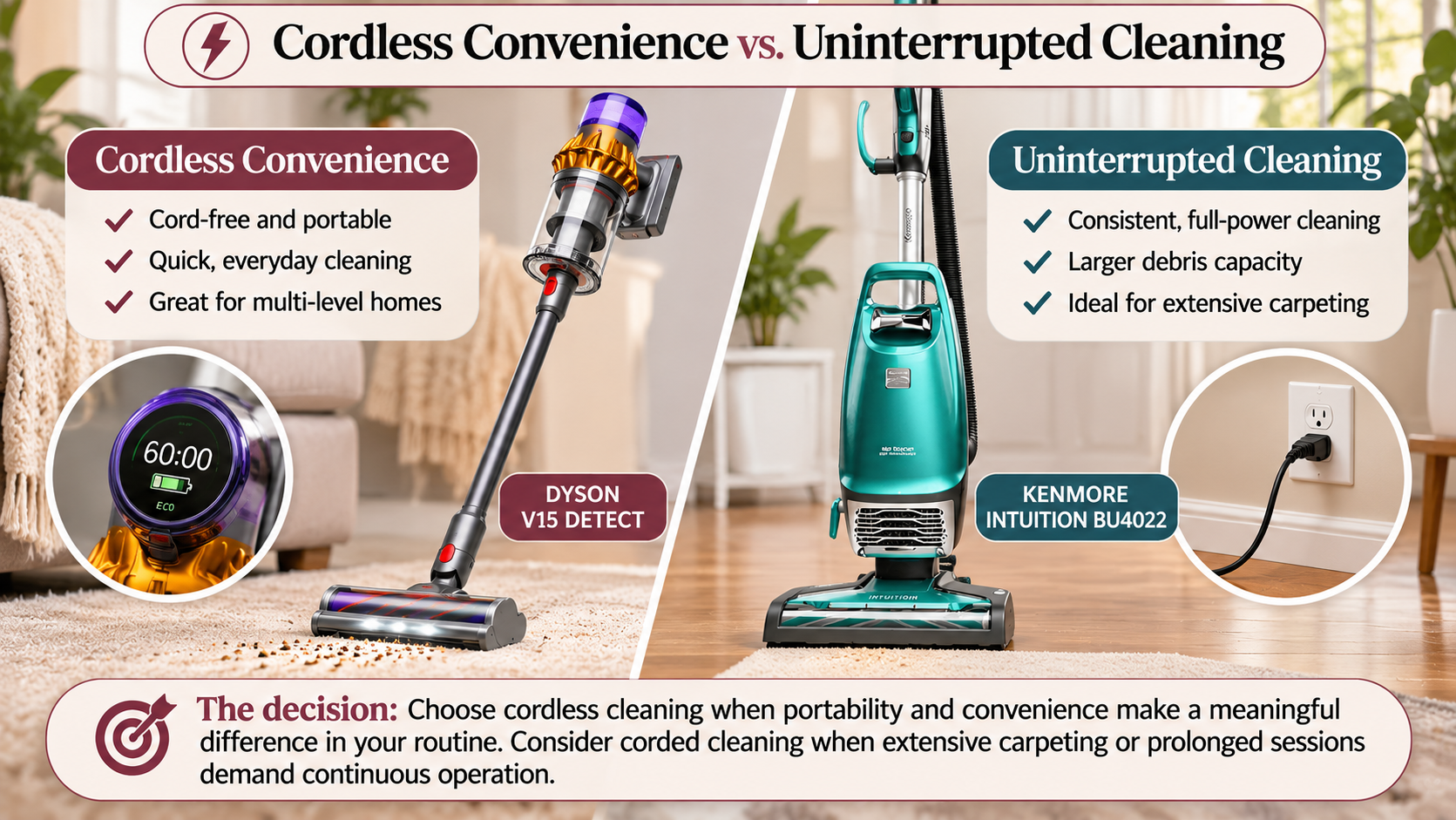
Cordless vacuums make everyday cleaning easier by eliminating power cords and outlet changes. However, maximum advertised runtime can be misleading when compared with actual cleaning demands.
Dyson advertises up to 60 minutes for the V15 Detect, but TechGearLab measured approximately nine minutes on maximum power and 64 minutes on its lowest setting. Higher suction, powered attachments, and demanding carpeting can substantially reduce endurance.
Dustbin size also matters. A battery may last long enough to clean several rooms, but repeated emptying can interrupt the process.
Corded uprights avoid charging interruptions and often provide larger collection capacity. The tradeoff is managing the cord, moving between outlets, and carrying a generally heavier machine.
The decision: Choose cordless cleaning when portability and convenience make a meaningful difference in your routine. Consider corded cleaning when extensive carpeting or prolonged sessions demand continuous operation.
4. Weight, Capacity, and Long-Term Ownership
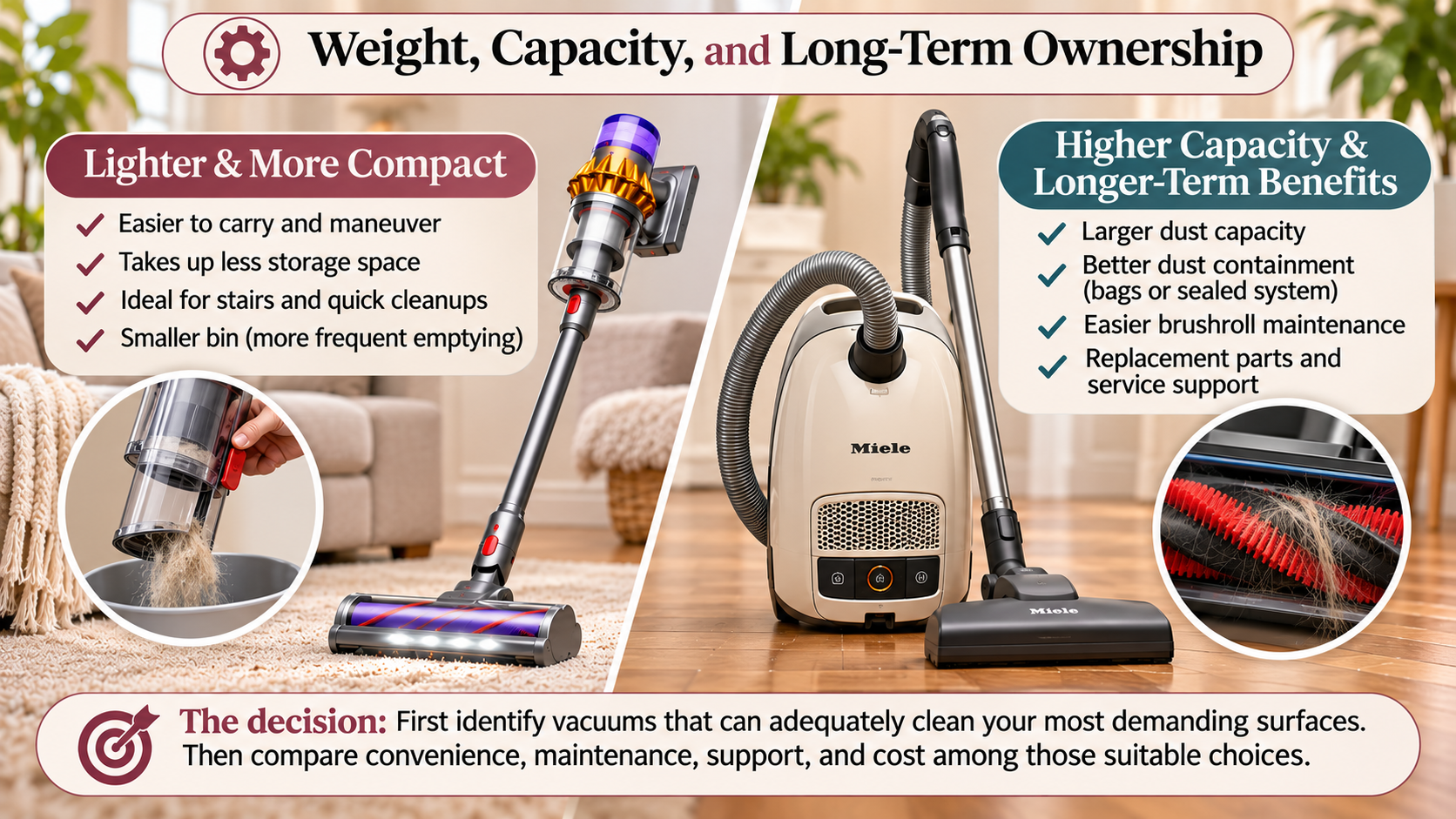
A vacuum's practical value depends on more than its purchase price. Carrying weight, storage, brushroll maintenance, dust disposal, replacement supplies, and repair support affect everyday ownership.
A compact machine may be easier to carry upstairs but require frequent emptying. A full-size canister may offer specialized floorheads and better dust containment while demanding more storage space.
Maintenance access is particularly important in homes with long hair or shedding pets. A brushroll that accumulates hair and is difficult to remove can turn an otherwise effective vacuum into a frustrating purchase.
Consider replacement bags, filters, batteries, and service availability before paying a premium. Manufacturer warranty coverage is useful, but it doesn't establish how long a particular machine will last.
The decision: First identify vacuums that can adequately clean your most demanding surfaces. Then compare convenience, maintenance, support, and cost among those suitable choices.
The Six Vacuums We Recommend
Each model below was selected for a distinct household need. We considered independent cleaning results, manufacturer specifications, handling, maintenance, filtration, ownership considerations, and U.S. purchasing availability.
These are not six interchangeable machines. Each recommendation reflects a specific advantage—and a compromise worth understanding before buying.
Best for Mostly Carpeted Homes: Kenmore Intuition BU4022
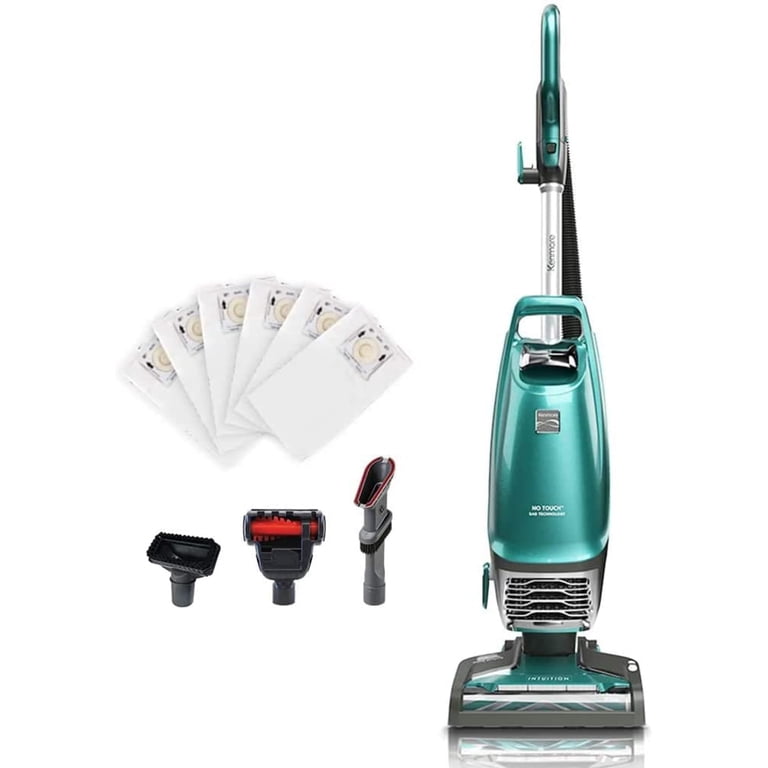
Best for: Homes dominated by low-pile or high-pile carpeting where effective ordinary debris pickup, bagged disposal, and accessible pricing matter more than premium construction.
The Kenmore Intuition BU4022 earns this recommendation because its cleaning performance exceeds what its price might suggest.
In TechGearLab's directly comparable tests, it collected 97% of debris from low-pile carpet and 73% from high-pile carpet. Its high-pile result exceeded those of several more expensive uprights, including the Dyson Ball Animal 3 Extra and Shark Stratos.
RTINGS also found favorable carpet-cleaning performance, particularly on high-pile surfaces.
The bagged design is another meaningful advantage. Kenmore's No Touch system seals the disposable bag during removal, reducing direct contact with accumulated debris. The BU4022 also has sealed HEPA filtration, a brushroll shutoff for suitable hard-floor cleaning, and a detachable Lift-Up pod for stairs and above-floor tasks.
Its included Pet HandiMate tool provides another cleaning option for furniture and smaller carpeted areas.
What Should You Know Before Buying?
The Kenmore's main weakness is hair maintenance. TechGearLab found that its pet-hair pickup was considerably weaker than its ordinary carpet-debris pickup. Hair can accumulate around the brushroll, which isn't especially convenient to remove for cleaning.
Its construction is also less substantial than premium alternatives, and the relatively short hose limits above-floor reach.
Why it wins: For households primarily concerned with removing dirt and debris from carpeting, the BU4022 combines impressive independent results, cleaner bag disposal, and a comparatively affordable purchase price. Heavy-shedding households should pay closer attention to the dedicated pet-hair recommendation below.
Sources: TechGearLab upright testing · RTINGS review · Kenmore specifications
Best for Mixed Flooring: Shark Stratos AZ3002

Best for: Homes with hardwood, area rugs, and carpeting where one convenient floorhead must handle several surfaces effectively.
The Shark Stratos AZ3002 stands out for combining strong everyday cleaning with a floorhead designed specifically for mixed flooring.
Its DuoClean PowerFins HairPro system uses a soft front roller alongside a powered brushroll. This arrangement helps collect fine dust and larger debris from hard floors while retaining the agitation necessary for many carpet-cleaning tasks.
In TechGearLab's comparison, the Stratos collected 97% of test debris from hardwood and 97% from low-pile carpet.
Those results make it particularly compelling for households that regularly transition between kitchens, living rooms, hallways, and carpeted bedrooms.
Powered Lift-Away adds another useful capability. The detachable pod allows the powered floorhead to reach beneath furniture while providing a more flexible configuration for stairs and above-floor cleaning.
Why Not the Newer Shark PowerDetect?
Newer Shark PowerDetect models introduce additional floor-sensing and handling features, but they don't automatically deliver better results on every surface.
In the same TechGearLab comparison, the Stratos outperformed the PowerDetect AZ4002 on hardwood and high-pile carpet debris. The PowerDetect Transformer LX5002 offered stronger high-pile pickup and additional configurations, but at greater cost and complexity.
For straightforward mixed-floor upright cleaning, the Stratos remains highly competitive.
What Should You Know Before Buying?
The Stratos is bulky, particularly when carried between floors. Its brushroll cannot be independently switched off through a dedicated control, so delicate carpeting and certain rugs require additional care.
Its high-pile debris performance also trails some carpet-focused competitors. The self-cleaning brushroll helps reduce hair accumulation but doesn't eliminate the need for maintenance.
Why it wins: The Stratos offers a useful balance of excellent hard-floor pickup, effective low-pile cleaning, integrated floorhead versatility, and Lift-Away functionality without the added complexity of newer convertible systems.
Sources: TechGearLab upright comparison · RTINGS review · Shark specifications
Best for Pet Hair on Carpet: Dyson Ball Animal 3 Extra

Best for: Carpeted households with substantial pet shedding, particularly those dealing with embedded hair and needing specialized upholstery-cleaning accessories.
The Dyson Ball Animal 3 Extra earns this category through exceptionally strong pet-hair pickup rather than universal superiority on every type of carpet debris.
In TechGearLab's pet-hair tests, it removed 78% of hair from low-pile carpeting and 82% from high-pile carpeting. Its high-pile result led the uprights in that comparison.
The de-tangling Motorbar is designed to move wrapped hair into the dustbin, reducing the need to manually cut hair from the brushroll. Three suction-gate settings help accommodate different floor surfaces.
The Extra configuration also includes a pet-grooming tool and a tangle-free turbine attachment, making it more versatile for furniture, pet beds, and other hair-covered surfaces.
RTINGS likewise found excellent pet-hair performance and strong overall cleaning capability, although carpet-debris pickup varies by surface.
How Does It Compare With the Shark Rotator LA502?
The Shark Rotator LA502 is a legitimate challenger. In TechGearLab's testing, it collected 86% of pet hair from low-pile carpet, exceeding Dyson's 78%.
However, the Dyson performed better on high-pile carpeting, removing 82% compared with Shark's 73%. Its de-tangling head also handled longer test hair effectively.
The Shark offers advantages in weight and Lift-Away handling, but its less consistent retail availability makes it a less secure primary recommendation for an evergreen buying guide.
What Should You Know Before Buying?
The Dyson is heavy and can require considerable effort to push on certain carpets. Carrying it upstairs and using its hose for elevated cleaning are less convenient than working with a lightweight cordless vacuum.
It also uses a bagless bin, so accumulated dust can become airborne during disposal. Its performance on ordinary high-pile carpet debris was weaker than the Kenmore Intuition's in TechGearLab's tests.
Why it wins: For carpet-heavy pet households, the combination of exceptional embedded-hair pickup, effective de-tangling, specialized accessories, and a currently supported U.S. product makes the Ball Animal 3 Extra a compelling choice—provided its weight is acceptable.
Sources: TechGearLab hair-pickup comparison · RTINGS review · Dyson specifications
Best for Dust-Sensitive Households: Miele Guard L1 Electro
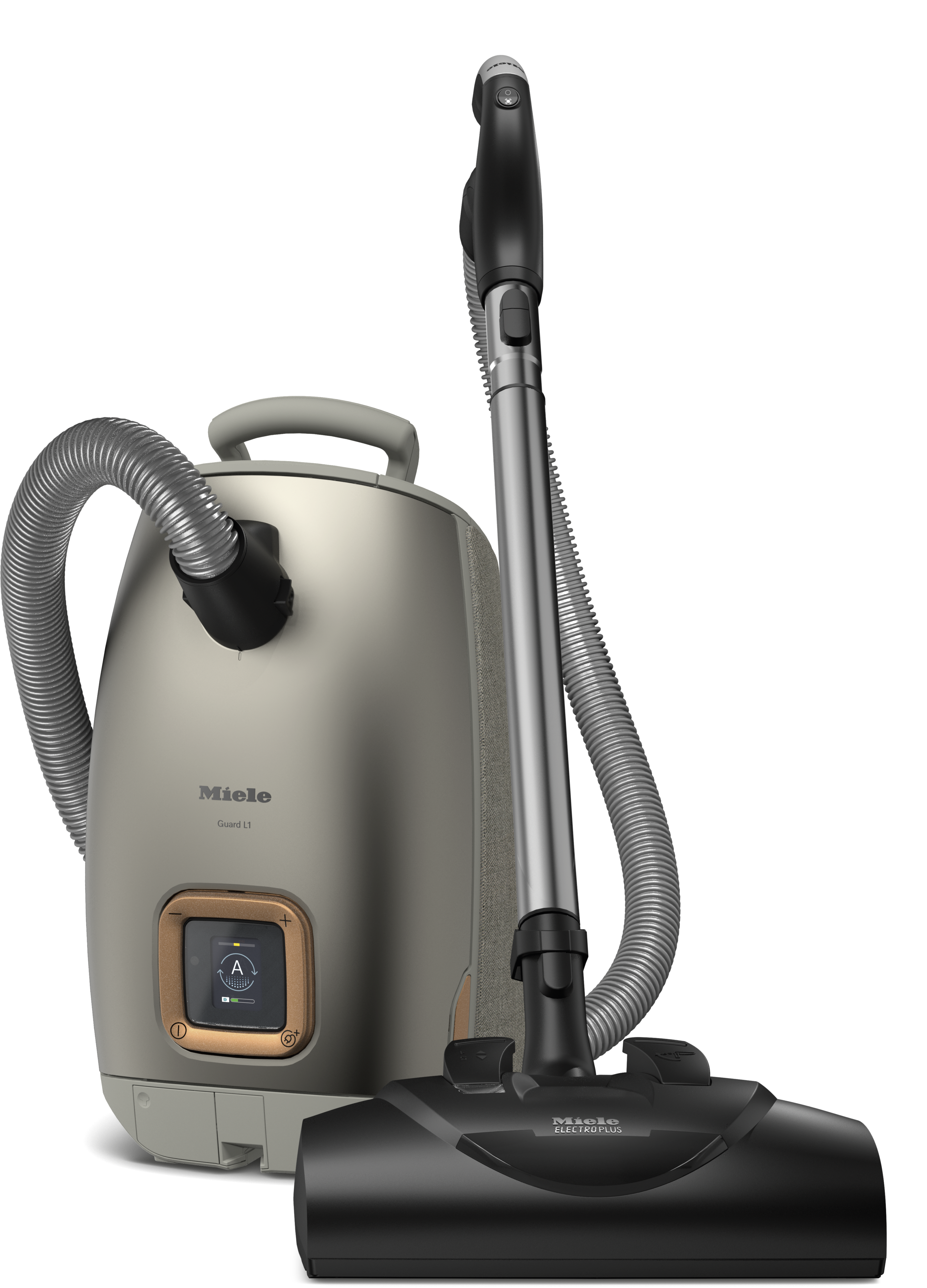
Best for: Households where fine-particle containment, cleaner disposal, and bagged cleaning take priority over initial purchase price.
The Miele Guard L1 Electro is the most expensive recommendation in this guide, but its particular strengths are meaningful for buyers concerned about dust escaping during cleaning and disposal.
It combines a sealed bagged system with an included HEPA AirClean exhaust filter. The ComfortFit bag system helps keep collected material contained when the bag is removed.
In RTINGS' independent review, the Guard L1 Electro delivered exceptional particle-filtration performance and very little dust release during bag disposal.
RTINGS also selected it as a leading HEPA vacuum for households prioritizing indoor air quality.
Unlike some straight-suction canisters, this exact U.S. model includes the SEB 228 Electro Plus powered carpet head. It also includes the SBD 365-3 combination floorhead for suitable hard floors and rugs.
Its approximately 36-foot operating radius, adjustable suction, LCD controls, and retractable cord contribute to a flexible cleaning system.
What Does the Premium Buy?
The Guard L1 Electro offers unusually effective measured particle containment, a cleaner bagged disposal process, premium construction, and specialized cleaning equipment.
However, excellent filtration doesn't automatically mean superior debris pickup on every surface. Independent tests found that certain cleaning tasks and debris types remain more challenging than others.
The purchase price is also substantial, and replacement bags and HEPA filters create ongoing expenses.
The canister, hose, and powered head require more storage and handling than a compact cordless vacuum.
What Should You Know Before Buying?
This recommendation applies specifically to the U.S. Guard L1 Electro, manufacturer material number 12704580, in Titanium PF.
Other Miele Guard L1 configurations may use different floorheads or filtration equipment. For example, the standard Nordic Blue configuration should not be assumed to include the same powered carpet head or HEPA filter.
Warranty coverage also depends on the specific model and authorized purchase conditions. Buyers should confirm the retailer's authorization before ordering.
Why it wins: The Guard L1 Electro offers independently demonstrated dust containment, effective bagged disposal, and versatile powered cleaning in a current U.S. model. Its premium cost makes sense primarily for households that place unusually high value on those advantages.
Sources: RTINGS review · RTINGS HEPA recommendations · Miele U.S. specifications
Best Cordless Vacuum: Dyson V15 Detect

Best for: Homes with mixed flooring, everyday cleaning needs, and a preference for cordless handling without sacrificing substantial cleaning capability.
The Dyson V15 Detect remains one of the most versatile cordless vacuums independently tested, even with newer models available.
In TechGearLab's testing, it collected 99% of test debris from hardwood, 94% from low-pile carpet, and 49% from high-pile carpet.
RTINGS also reported excellent pet-hair pickup and strong overall cleaning performance.
Its included Fluffy Optic head helps reveal fine dust on hard floors, while the Digital Motorbar provides powered carpet cleaning. A particle sensor automatically adjusts suction, and the LCD display supplies remaining-runtime information.
The V15 converts into a handheld vacuum and uses a replaceable click-in battery. The precise accessory package varies by configuration, so buyers should verify included upholstery and pet tools rather than assuming every V15 bundle is identical.
Why Not the Newer Dyson V16?
Newer isn't automatically better for every cleaning task.
In RTINGS' direct comparison, the V15 performed better on low-pile and high-pile carpeting than the newer V16 Piston Animal Submarine.
The V16 offers improvements in construction and certain features, but these did not translate into superior carpet-cleaning results in that testing.
The V15 therefore remains a compelling choice for buyers seeking proven cordless performance across several surfaces.
What Should You Know Before Buying?
Battery endurance varies dramatically by setting. TechGearLab measured approximately nine minutes at maximum power, compared with much longer operation at its lowest setting.
RTINGS measured approximately 0.12 gallon of usable collection capacity, making frequent bin emptying a realistic concern in larger homes.
The V15 also uses a hold-down trigger, and emptying its bagless dustbin can disturb fine particles.
Why it wins: The V15 combines strong independent cleaning results, excellent versatility, useful automated features, and manageable weight. Its limitations are meaningful, but for households that prioritize cordless convenience, the overall balance remains difficult to beat.
Sources: TechGearLab review · RTINGS review · Dyson U.S. specifications
Best for Smaller Homes: Levoit LVAC-300
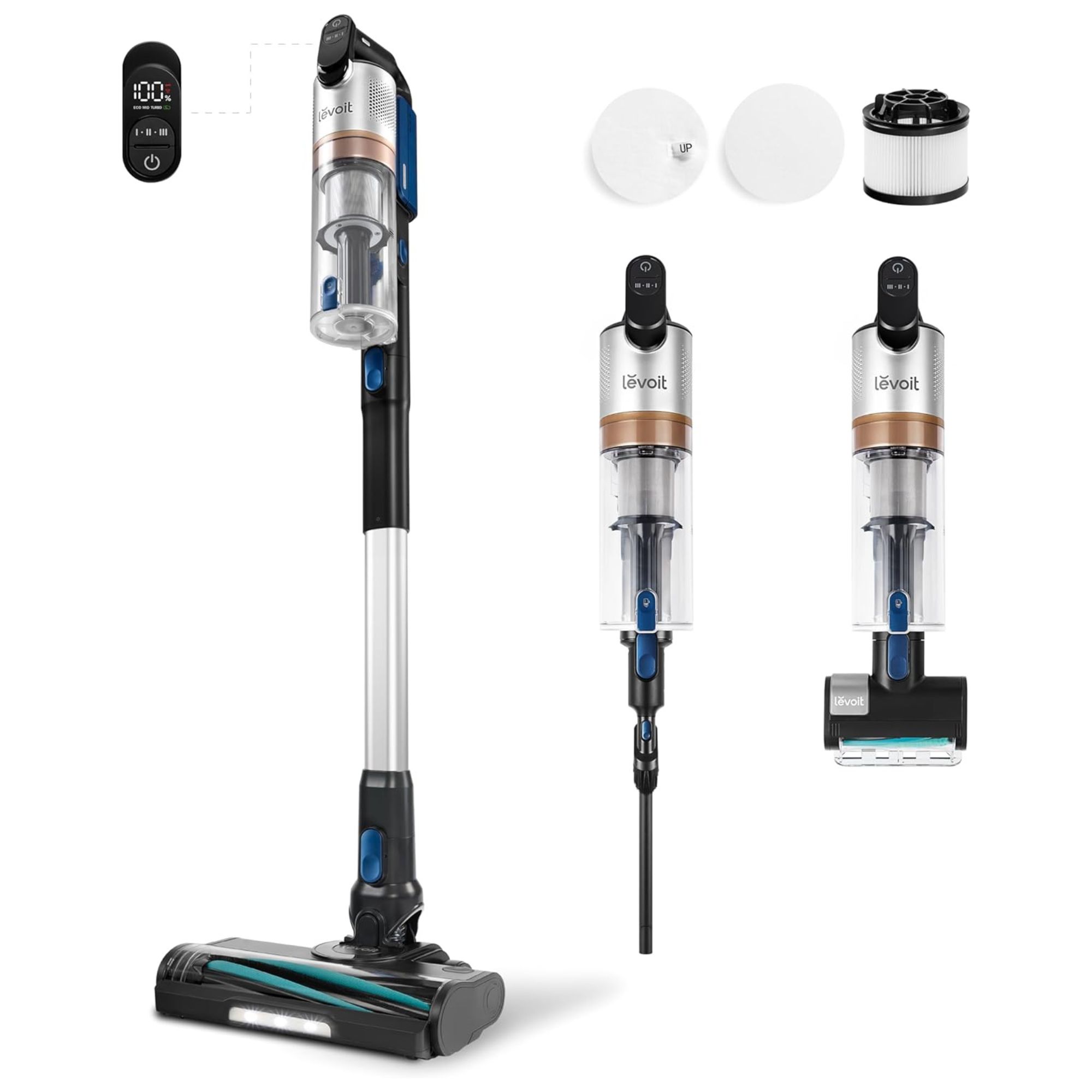
Best for: Apartments, smaller homes, and households with mostly hardwood or low-pile carpeting that want effective everyday cleaning without a full-size vacuum.
The Levoit LVAC-300 offers a compelling combination of cleaning capability, collection capacity, convenience, and price.
In TechGearLab's testing, it collected 97% of test debris from hardwood and 91% from low-pile carpeting.
Its performance on high-pile carpeting was less impressive, but it performed well on the surfaces most relevant to many smaller households.
The self-standing design is a useful distinction. Unlike many cordless sticks that require a wall mount or support, the LVAC-300 can stand upright during ordinary cleaning breaks.
Its 0.75-liter advertised dustbin, removable battery, and included upholstery tool also contribute to practical everyday use.
Levoit sells compatible replacement batteries, filters, and chargers, providing clearer ongoing ownership support than some inexpensive cordless competitors.
Why Not the Dyson V12 or BISSELL FurFinder?
The Dyson V12 Detect Slim is lighter at approximately 5.2 pounds, making it appealing when minimizing carrying weight is the overriding priority.
However, it has a much smaller usable dustbin, costs considerably more, and has experienced inconsistent U.S. availability.
The BISSELL PowerClean FurFinder 4052 is a credible lower-priced alternative. In TechGearLab's testing, it delivered similar low-pile and hardwood pickup.
The Levoit offers the stronger overall combination of collection capacity, runtime, lighter handling than the BISSELL, and general household versatility.
What Should You Know Before Buying?
The LVAC-300 isn't intended to compete with substantial corded carpet machines on demanding thick carpeting.
Its pet-hair pickup also varies by surface. TechGearLab found that hair removal was considerably stronger on low-pile than high-pile carpet.
Levoit's advertised maximum runtime is measured under favorable low-power conditions, not continuous high-power carpet cleaning.
Why it wins: For smaller households with predominantly hard floors and lighter carpeting, the LVAC-300 delivers effective cleaning, practical capacity, useful portability, and better value than many premium cordless models.
Sources: TechGearLab review · BISSELL comparison · Levoit specifications
When One Vacuum Isn't Enough
A capable primary vacuum should handle the most important cleaning tasks in your household. However, certain situations benefit from a complementary machine rather than expecting one vacuum to do everything.
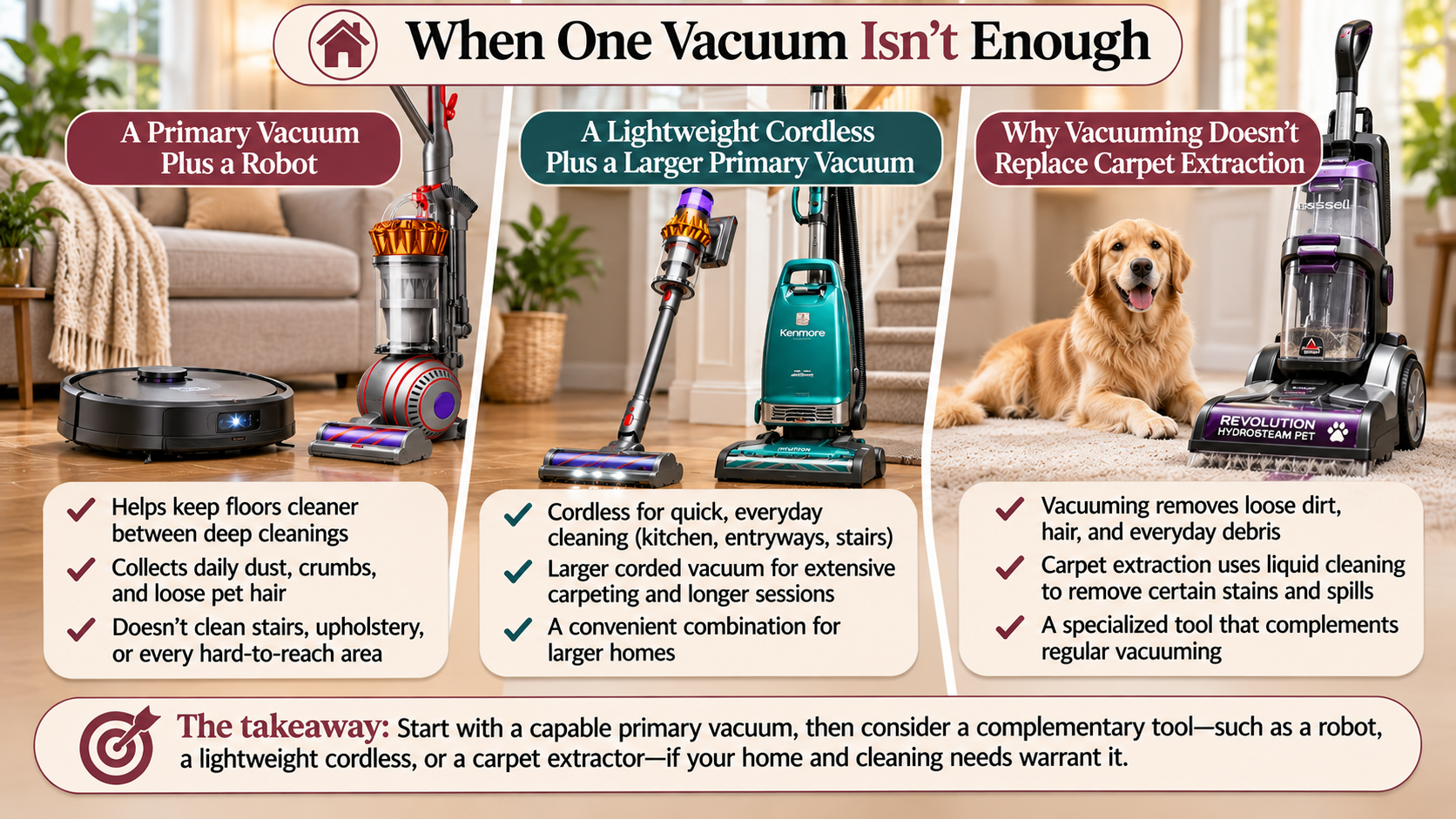
A Primary Vacuum Plus a Robot
Robot vacuums can reduce routine cleaning work on accessible floors, collecting crumbs, dust, and loose pet hair between more thorough sessions.
However, robots generally cannot clean ordinary stairs, upholstered furniture, or every difficult edge and corner. Their performance on thick carpets also varies considerably.
A robot is therefore best considered an automated maintenance tool rather than an automatic replacement for a capable primary vacuum.
A Lightweight Cordless Plus a Larger Primary Vacuum
In larger homes, a lightweight cordless can make everyday kitchen, entryway, and stair cleaning easier, while a larger corded machine handles extensive carpeting and longer cleaning sessions.
This combination can be convenient, but purchasing two machines isn't necessary when one already meets the household's cleaning needs.
Why Vacuuming Doesn't Replace Carpet Extraction
Ordinary dry vacuuming collects loose dirt, hair, and debris. Carpet extraction addresses a different problem: removing certain stains, spills, and wet soiling using liquid cleaning and recovery.
A carpet extractor is therefore a specialized supplement, not a replacement for regular vacuuming.
For households dealing with carpet stains and pet accidents, see Plumosity's BISSELL Revolution HydroSteam Pet — Plumosity Certified feature.
Final Guidance: Buy for Your Home, Not the Specification Sheet
The right vacuum doesn't need to win every laboratory comparison. It needs to clean the surfaces, debris, and spaces that matter in your home.
Start with your most demanding flooring. Then consider how easily you can maneuver, carry, empty, and maintain the machine.
Find Your Best Fit
The best purchase isn't necessarily the newest, most powerful, or most expensive vacuum. It's the one that cleans effectively without making everyday cleaning unnecessarily difficult.
Frequently Asked Questions
Do I Need a Powered Brushroll for Carpet?
Powered brushrolls help loosen embedded debris from many carpet types, but they aren't appropriate for every construction.
Certain looped, delicate, or long-pile carpets may require reduced agitation or suction-only cleaning. Always follow the carpet manufacturer's care and warranty instructions before selecting a vacuum with aggressive powered brushes.
Can One Vacuum Clean Both Hardwood and Thick Carpet?
Yes, provided the machine has suitable floorheads and adequate independent cleaning performance for both surfaces.
Dedicated hard-floor and powered carpet heads can provide greater flexibility, while a well-designed universal head may reduce the need for attachment changes.
Neither arrangement automatically wins. The right choice depends on the surfaces, carpet construction, and cleaning routine.
Is a Bagged Vacuum Better for Allergies?
A well-designed bagged vacuum can reduce dust exposure during disposal, especially when the bag seals before removal.
However, bag type alone doesn't establish filtration performance. Whole-machine sealing, exhaust filtration, and measured particle emissions also matter.
In a 2026 investigation of 15 vacuums, RTINGS found that bagged designs generally offered cleaner disposal, while certain well-filtered bagless machines also performed exceptionally during operation.
No vacuum should be assumed to eliminate allergens or guarantee a medical benefit.
Is Cordless Cleaning Powerful Enough to Replace a Corded Vacuum?
For many households, yes. High-performing cordless machines such as the Dyson V15 Detect can handle substantial everyday cleaning across several floor types.
However, extensive carpeting, prolonged cleaning sessions, and heavy debris loads may favor corded machines with larger collection capacity and uninterrupted operation.
How Important Is Suction Power?
Suction matters, but advertised suction figures don't establish actual cleaning superiority.
Floorhead design, airflow, agitation, surface compatibility, and debris type all influence pickup.
Laboratory suction measurements are useful for understanding vacuum engineering, but independent pickup tests on surfaces similar to yours provide more useful purchasing evidence.
How Much Should I Spend on a Vacuum?
Spend enough to meet your household's cleaning requirements reliably and conveniently, but don't assume premium pricing guarantees better results.
A relatively affordable bagged upright may provide excellent carpet performance, while a premium cordless may justify its price through portability and specialized cleaning features.
Consider replacement bags, filters, batteries, repair support, and maintenance when evaluating long-term ownership value.
About Our Research
Plumosity's recommendations are based on independent research involving published cleaning tests, official manufacturer specifications, and relevant ownership considerations. We did not conduct our own vacuum laboratory testing.
We considered surface-specific debris pickup, pet-hair removal, filtration, dust disposal, maneuverability, maintenance, and practical ownership compromises.
Independent publishers use different test procedures. Results from different laboratories are not combined into a single numerical ranking, and manufacturer specifications are distinguished from independently measured performance.
Our recommendations reflect the available evidence and U.S. product information reviewed in November 2026. Product configurations, availability, prices, and independently established performance comparisons may change. We review substantial new evidence when updating the guide.
Some links in this article may be affiliate links, which means Plumosity may earn a commission—at no additional cost to you—if you make a purchase through them. Affiliate availability does not determine whether a product earns an editorial recommendation.